A Strategy for This Moment
This is a decisive moment for health justice.
Health care now accounts for nearly one-fifth of the U.S. economy. Private equity firms, health system conglomerates, technology platforms, and venture-backed innovators are reshaping delivery systems at a pace that outstrips regulatory adaptation. At the same time, a large-scale reduction in the federal workforce, cuts and the restructuring of Medicaid, and administrative disinvestment are increasing instability for families and communities.
The decisions being made today, often quietly — in investment committees, corporate boardrooms, state budget offices, and federal agencies — are not abstract policy debates. They determine whether a community hospital remains open, whether a family stays insured, whether medical debt crushes someone for years, and whether caregivers can continue supporting the family members, older adults and people with disabilities who rely on them in an increasingly strained system.
This is not a moment for incrementalism. It is a moment for disciplined execution, early intervention, and infrastructure that can operate at scale. Community Catalyst’s 2026–2028 strategy is built for this environment. It recognizes that the health care system is a public service framework that operates in a capitalized marketplace. If communities are not organized, informed, and positioned to influence the policies that determine that marketplace, they will continue to absorb its instability.
Our work is designed to mitigate harm now while delivering durable outcomes that strengthen health and economic stability for communities over time.

Why This Moment Requires a Different Approach
Across the country, the warning signs are unmistakable.
People are losing coverage as historic cuts to Medicaid and rollbacks of affordability protections take hold, compounded by payment and delivery systems that are confusing and fragmented. Federal oversight has been reduced. Regulatory guardrails have been weakened and enforcement is slower. Families delay care as costs rise and safeguards weaken. Caregivers shoulder enormous responsibility with little support or voice. Communities learn about hospital closures only after decisions are final and harm unavoidable.
At the same time, this is a moment of real opportunity. Innovation in areas like women’s health is attracting unprecedented attention and investment. But history shows that innovation, when disconnected from communities and accountability, can reinforce the same dynamics that increase cost, deepen instability and cause economic harm.
1/5 of the U.S. economy is comprised of health care costs
This moment calls for a different approach. One that moves earlier, aligns systems more intentionally, and brings community insight into decisions before harm occurs. That is where Community Catalyst delivers unique value — by connecting data, lived experience and execution at the points where outcomes are shaped.
For decades, advocates have fought for coverage expansions and strengthened protections within the health system. But rising costs, consolidation, administrative complexity, and policy volatility are compounding faster than incremental fixes can keep up.
A Cost We See Too Often
When Atlanta Medical Center closed, thousands of patients lost access to care overnight. Families who relied on the hospital for prenatal care and chronic disease management were forced to travel farther, wait longer, or forgo care entirely.
The closure followed years of financial strain and market pressure, shaped by decisions made far from the communities most affected. By the time residents learned what was coming, the outcome was decided.
What happened in Atlanta is not unique. Similar dynamics are playing out in rural communities across the country, where a single hospital closure can eliminate nearby emergency care for entire regions. Different geography, same vulnerability.
This is a systemic challenge. It requires a systemic response.
Our Four Strategic Priorities for Health Justice
A State–Federal Agenda for Durable Health Care Reform
In a fragmented federal environment, states are increasingly the primary arena for health policy innovation — and regression. Our focus is not only on expanding coverage, but on ensuring that coverage functions: reducing churn, administrative barriers, denials, and medical debt. We translate complex financing and regulatory policy into concrete implementation strategies that protect real people.
Learn More
Learn MoreCaregiving and Aging in a Capital-Constrained System
The nation is aging. By 2040, about one in five Americans will be age 65 or older, up from one in eight in 2000. Caregiving needs are reshaping labor markets, Medicaid budgets, and family economics. We build leadership pipelines among caregivers, embed their voices in Medicaid policy decisions, and align aging networks with technology and system redesign efforts so caregiving resources support real family needs rather than purely profits.
Learn More
Learn MoreCommunity–Health Market Watch
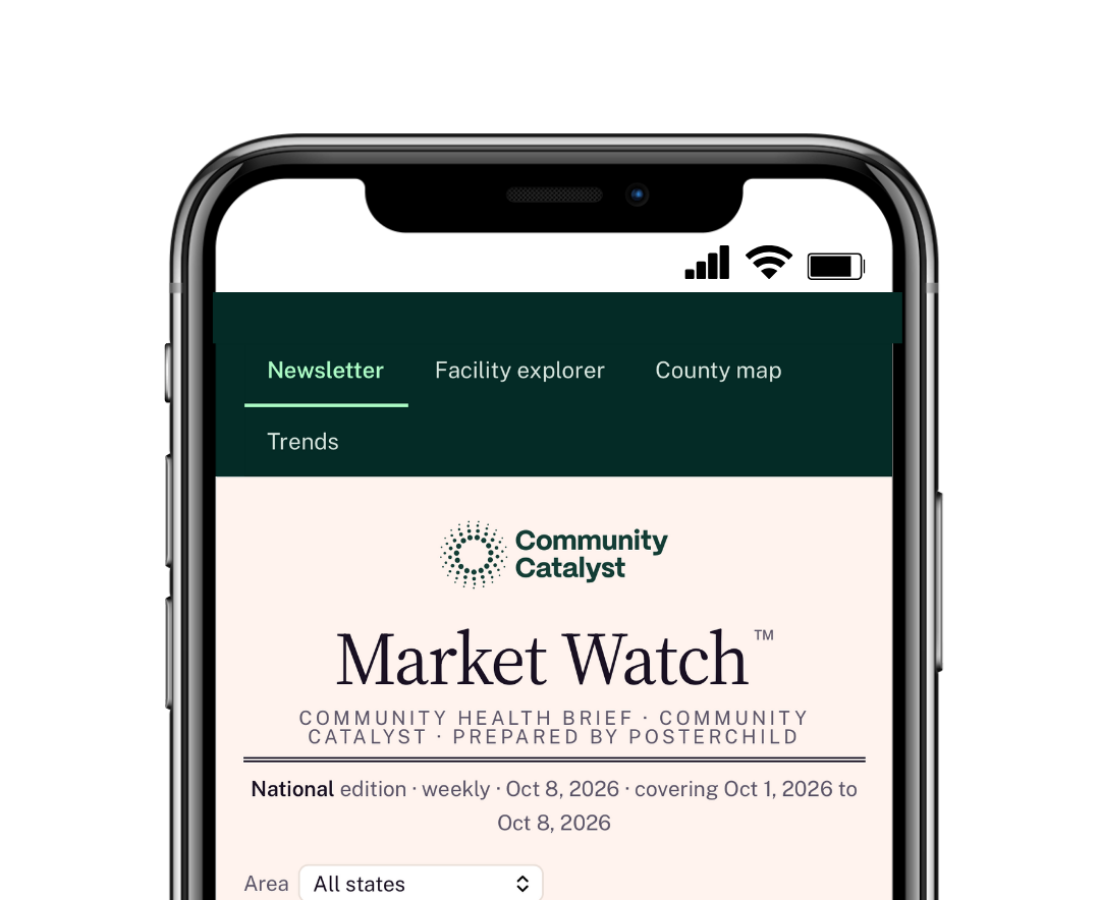
We conduct early-warning financial and market analysis, track consolidation trends and ownership shifts, deploy rapid-response organizing, and advance community-driven negotiation tools that enable intervention at the state and local level to mitigate access loss and harm before they become irreversible.
Learn More
Learn MoreHealth Justice Intelligence
We integrate lived experience, health and economic data, organizing power metrics, and implementation performance into a national infrastructure that allows partners and funders to see where strategies are delivering impact and where intervention is needed most.
Learn More
Learn MoreBuilt for the Future of Health Care Transformation
Economic pressure will continue. Capital will continue to move. Political control will shift. During these inevitable changes, we are positioning communities to shape health care reform and market evolution.
Community Catalyst’s role is to ensure that community power, policy provisions, and market accountability move in tandem — so families are not perpetually absorbing the burden of system instability.

The return on this strategy is measured in coverage stability, reduced medical debt, continued access to care, and stronger community authority over health system decisions.
We will mitigate harm — and build durable infrastructure — so that communities are positioned not just to survive this period of transformation, but to shape what comes next.