Even When Healthcare Isn’t Officially on the Docket, Supreme Court Decisions Have Big Impacts on Access to Coverage and Care
Before we turn our attention to the upcoming Supreme Court term kicking off next month, it is worth taking a moment to recap the prior term. Though the recent term will not go down in history as one where healthcare often made headlines, the topics elevated and outcomes raised red flags about the future of our civic institutions and their increasingly complex intersections with our healthcare system.
Let’s examine a few of the biggest issues the Court ruled on this session and what they mean for our work:
Birthright citizenship
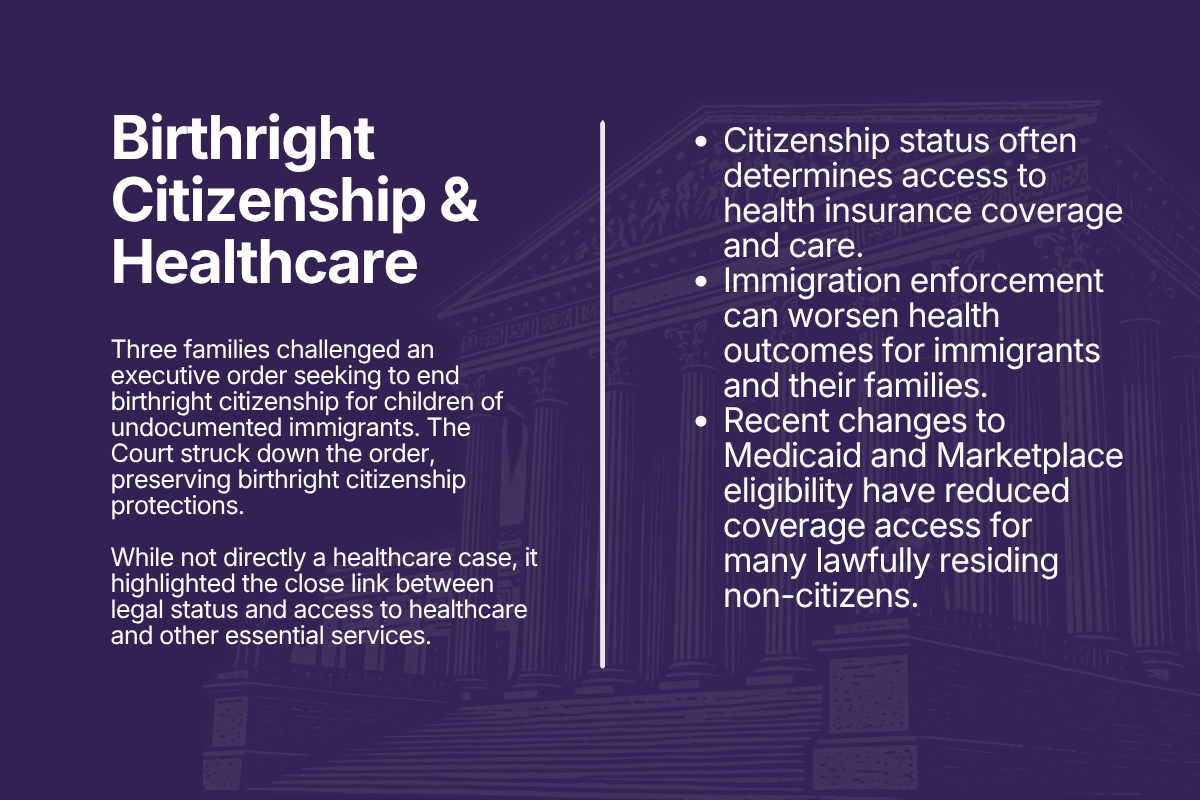
Three families challenged an executive order issued by President Trump denying citizenship to the children of undocumented immigrants. The implementation of this order would have upended more than 150 years of legal precedent along with the lives and livelihoods of millions of people across the country. Ultimately, the Court ruled in a 6-3 decision that the executive order is unconstitutional, protecting birthright citizenship as we know it.
Even though this case was not, on its face, about healthcare, we and other healthcare advocates watched it closely given the entangled relationship between legal status and the medical systems we have in place.
For one thing, citizenship status often determines access to coverage, and access to coverage too often determines access to care. From the moment a person in this country is born, families and healthcare providers make decisions based on health insurance coverage and eligibility that can follow people throughout their lifespan, with implications for which (if any) public benefits they qualify for, what kinds of documentation they need, and how safe they are to access care given various social, political, and economic roadblocks. For another, immigration enforcement – including arrest, detention, and deportation – can itself cause or exacerbate poorer health outcomes and mortality for immigrants and their families, including for those who are detained and those left with lingering trauma and fewer resources at home when a loved one is taken by the state.
This case also intersects with several other policies that have recently come out of this administration and Congress that will impact immigrants and their families and could undermine their access to care.
The newly released Public Charge rule is one such example; it gives even broader discretion to federal officials making determinations about someone’s eligibility for permanent status in the U.S., allowing for the consideration of factors such as whether a green card applicant or a member of their family had previously utilized public benefits they were eligible for. The restrictions on immigrant access to ACA tax credits included in H.R. 1 and the increased ICE budgets pushed through Congress in both H.R. 1 and another reconciliation bill passed in June 2026 also demonstrate a concerted effort to continue to target immigrants, create legal barriers to their access to coverage, and promote a chilling effect within immigrant communities where even people who are eligible for benefits and coverage may choose to forgo them to avoid high-risk interactions with the government and related institutions.
Transgender athletes
The Court combined cases from West Virginia and Idaho to unanimously uphold statewide prohibitions on transgender athletes playing women’s and girls’ sports in schools. In total, 27 states have enacted similar laws and two additional states have prohibitions spelled out in state regulations, but not (yet) cemented in state law.
While not explicitly healthcare focused, this case also raises alarms for healthcare advocates due to both its expected impacts on health outcomes for trans youth and its proximity to other trans-exclusionary policies.
Research consistently shows that participating in youth sports is good for young people. From ensuring regular physical activity to improving strength and agility to increasing mental health and emotional regulation, playing sports can unlock many pathways to physical and mental health. Conversely, when youth are specifically prohibited from participating fully in school athletics based on their gender identity, they feel a deeper sense of isolation and ostracization, and report worse health outcomes.
In addition to the individual, health-related harms to trans youth stemming from these bans – and the Court’s sanctioning of them – the ruling comes at a point in our political history when access to healthcare for trans and nonbinary youth is also increasingly under attack.
To date, 27 states have banned or limited gender affirming care for people under age 18, bolstered by a related Supreme Court ruling last year. Twenty-four of these states also have provisions in their laws that punish doctors for providing gender affirming care, which, according to the Association of American Medical Colleges can include a “range of social, psychological, behavioral, and medical interventions… from counseling to changes in social expression to medications (such as hormone therapy)” designed to support and/or affirm a patient’s gender identity.
At the federal level the Trump administration has used its rulemaking authority to ban Medicaid and CHIP from covering gender affirming care for youth, threaten funding for hospitals and health centers that provide gender affirming care, prohibit the inclusion of gender affirming care as an essential health benefit, and generally restrict access to care for both trans youth and adults. The Supreme Court also ruled overwhelmingly in a separate case this term that Colorado’s ban on LGBTQ+ “conversion therapy” violated the Constitution, hamstringing the state in its efforts to protect patients from practices inconsistent with the standards and official positions of the American Medical Association, the American Academy of Pediatrics and the American Psychological Association.
The confluence of these decisions – at all levels and every branch of government – is resulting in more limited access to care at the same time threats to safety and wellness are on the rise.
Democracy
Two cases this term took aim at voting rights, and though their outcomes were different, the issues they raise pose major threats to both democracy writ large and the health and wellness of people of color, people with low-incomes, and people with disabilities.
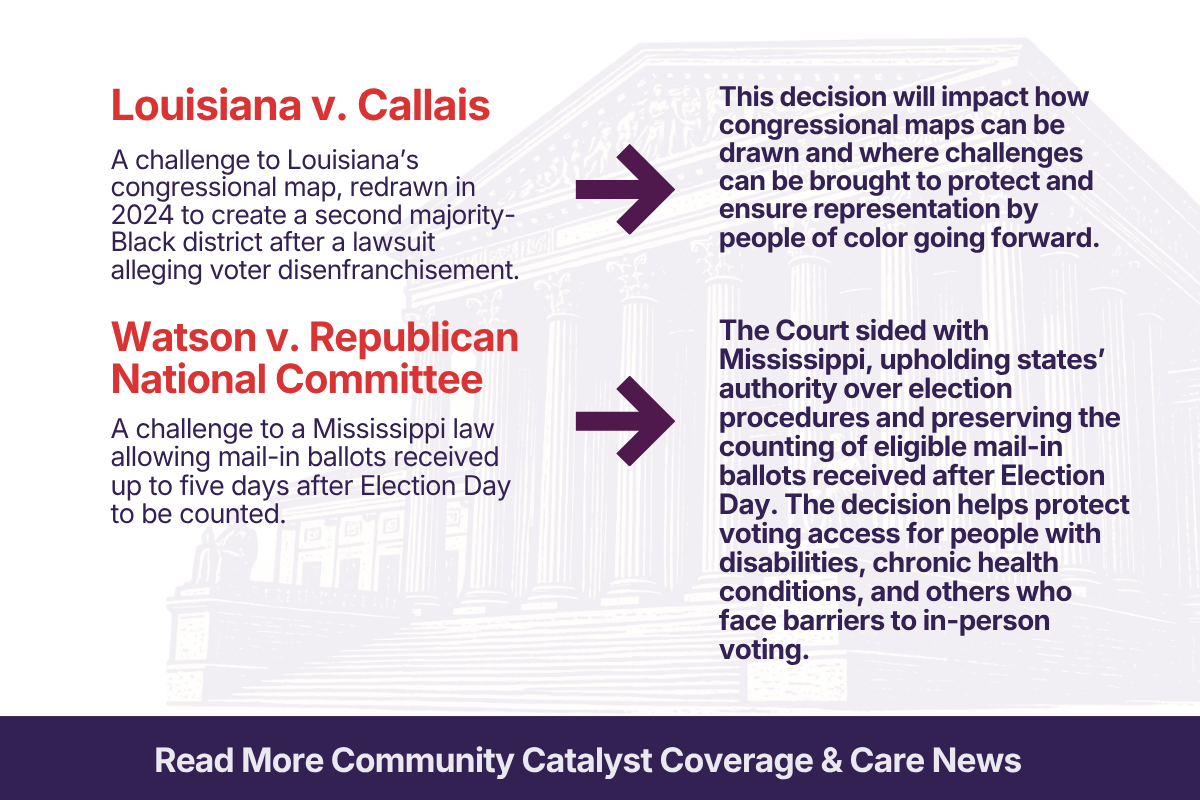
The first case was a challenge to Louisiana’s congressional district map, which had been redrawn in 2024 to include a second majority-Black congressional district in response to a previous lawsuit claiming the state maps had been impermissibly gerrymandered to disenfranchise Black voters. The Court’s ruling not only nullified the Louisiana map, but also severely undermined Section 2 of the 1965 Voting Rights Act, which had been key to the creation and maintenance of majority-minority districts since its inception.
This decision will impact how congressional maps can be drawn and where challenges can be brought to protect and ensure representation by people of color going forward. But it will also have implications for healthcare policy for generations to come.
Political disenfranchisement and poor health outcomes are intrinsically linked. Studies have shown that racialized gerrymandering – specifically where people of color are the minority – can lead to reduced access to health services like Federally Qualified Health Centers and inadequate prioritization of community needs like investments in hospitals, Medicaid, and other public programs that support health.
Studies have also shown that people with declining health are more likely to distrust community and government institutions that are supposed to support their wellness, and in turn vote less often. As a result, the voices of people who need healthcare most and who are most likely to know first-hand how vital programs like Medicaid and SNAP are, become excluded from the electoral process.
The second case was brought by the Republican National Committee (and others) to challenge a Mississippi law that allows mail-in ballots postmarked by Election Day to be counted if they are received up to five days after the fact. This time, the Court sided with Mississippi, preserving states’ authority over election procedures.
Though unsuccessful, it’s worth noting that this challenge, and others like it, also attempted to further disenfranchise already marginalized voters. While mail-in voting is becoming more popular across the board, it is particularly important for people with disabilities and chronic conditions, including older adults with limited mobility or transportation options, who face more barriers to in-person voting. Preserving access to civic engagement and democratic participation for every voter should remain an essential priority.
It is clear from both the Court’s decisions this term and the ongoing administrative and legislative attacks on access to care that our healthcare system and the people it serves needs strong and strategic champions more than ever.
Healthcare advocates have a significant role to play in educating and activating policymakers at all levels of government. This work includes holding both elected officials and leaders of institutions accountable for creating and building on systems that support access to affordable, quality care. To that end, we invite you to join our #VoteLikeHealth campaign below and bring healthcare to the ballot box on Election Day.