Integrating Coverage and Care for Dually Eligible People and their Caregivers in the South
By Linda Goler Blount, MPH, President and CEO of Community Catalyst and Dom Kelly, Founder, President and CEO of New Disabled South.
A new MedPAC/MACPAC Duals Data Book reveals the scale of a challenge hiding in plain sight: nearly 12.8 million people are dually eligible for both Medicare and Medicaid (Duals), yet face some of the most fragmented care in the U.S. The recent National Family Caregivers Month reminds us that behind these numbers are families struggling to provide essential care amid systemic barriers. Across the South, poverty, workforce shortages, and fragmented coverage continue to undermine both health and economic security. And, the intersection of Medicare and Medicaid often determines whether people remain stable or fall into crisis. This was exactly the case for Katie.
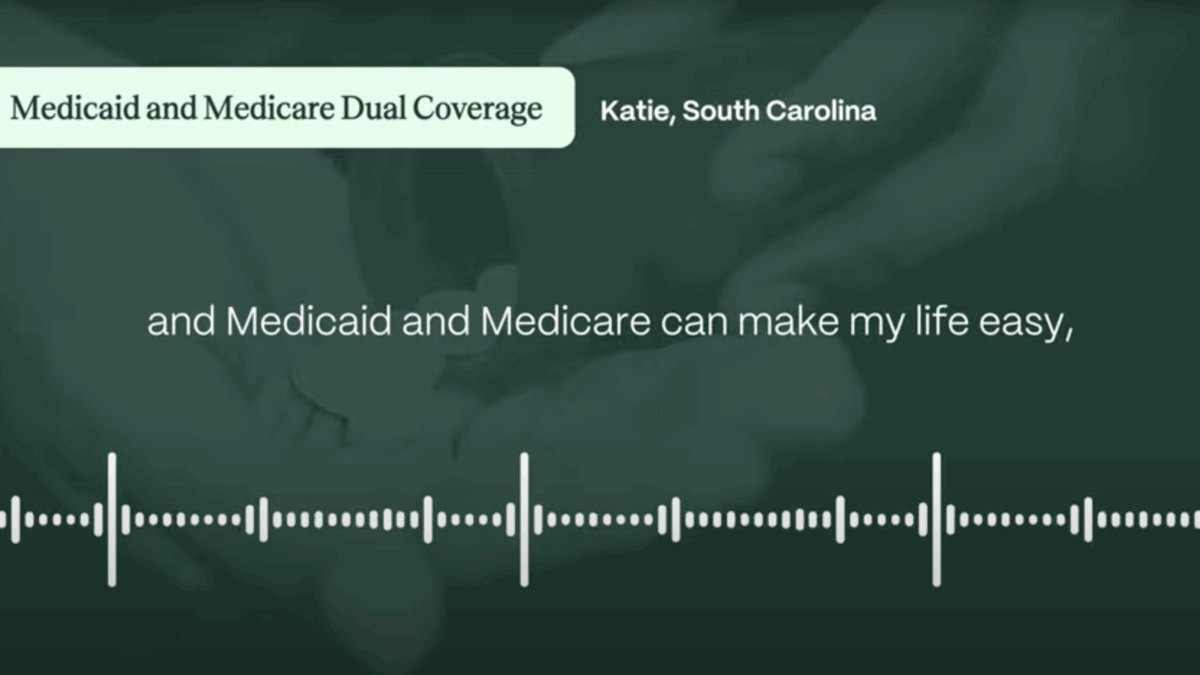
When Katie Dunmore was diagnosed with a leaky heart valve, her doctor in South Carolina prescribed Eliquis, a stroke-prevention medication she would need for the rest of her life. What seemed like a straightforward treatment quickly became a crisis when she learned that her Medicare coverage didn’t fully cover the drug. Paying out-of-pocket would cost her more than $2,000 for a three-month supply — an impossible amount for someone on a fixed income.
“Eliquis is one name I remember because it’s so expensive you can’t help but learning the name,” Dunmore said. “It’s so expensive I don’t see how many people can afford to have it.”
Her doctor helped her find a solution: Medicaid. Now, with both Medicare and Medicaid coverage, Katie can fill her prescription each month without worrying about choosing between her health and her bills.
Without [Medicaid and Medicare], I can’t see where I could make it—to pay the light bill, car insurance, house insurance. It’s just too much for one person.
“When you get older, if you’re able to pay your bills, pay for your medicine, go to the doctor when you need to go — that means a lot,” Dunmore said.
Katie’s experience shows what happens when systems align — and what’s lost when they fail. Duals are among the most marginalized within our healthcare system. Most are older adults or people with disabilities living on low, fixed incomes, often managing multiple chronic conditions. Fragmentation makes this worse: although duals represent just 20% of Medicare beneficiaries, they account for 26% of fee-for-service spending because separate funding streams and poor coordination force high-need patients to navigate multiple systems. When coverage breaks down, millions of people like Katie face impossible choices that jeopardize their health and independence. We need a bold vision of seamless care designed around human lives rather than institutional boundaries.
Dismantling Unnecessary Barriers to Care
Across the South, fragmented systems, low reimbursement rates, and administrative complexity create barriers to care for those who depend on both programs. Providers are discouraged from accepting patients, families face delays and denials, and caregivers must navigate multiple agencies to fill the gaps that policy should close. These challenges are magnified in Southern states where Medicaid expansion remains incomplete — compounding the fragmentation highlighted in the MedPAC/MACPAC Duals Data Book. When coverage and coordination break down, high-need individuals are forced to navigate multiple systems, driving costs and worsening outcomes.
The same policy choices that determine whether people can age or live with dignity also shape the conditions of the caregiving workforce. In Georgia alone, more than 7,000 people are waiting for home- and community-based services (HCBS) — and across 14 Southern states, that number exceeds half a million, representing three-quarters of all people waiting nationwide. Each number represents someone who needs help now but must wait because the system lacks capacity. The result is uncertainty, stress, and too often, declining health and financial stability.
Behind every story like Katie’s are caregivers — family members, home health aides, and personal attendants — whose labor makes community living possible. Yet these caregivers face many of the same systemic barriers as the people they support. The direct care workforce is projected to add 860,000 jobs over the next decade, but low pay, poor benefits, and unstable hours threaten that growth. The median wage is $16.77 an hour, and 37 percent of these workers live at or near the poverty line. Many are themselves disabled or dually eligible. Cuts to Medicaid reimbursement rates or new administrative hurdles only make it harder to stay in the field, fueling turnover and worsening access to care.
Only a fraction of caregivers —1.9 million of the estimated 63 million — receive pay for their labor, meaning 97 percent of caregivers in the U.S. are unpaid. The health of the care system depends on both groups, yet both remain undervalued and under-supported. When caregivers leave, continuity of care suffers. Families are left to fill the gaps — reducing work hours, taking on debt, or providing care without training or support. The result is a fragile ecosystem linking the experiences of dually eligible people and their caregivers in shared precarity.
In Community Catalyst’s recent report, continuity emerged as a central theme in a pilot program of HCBS quality measures. Participants described how care is often disrupted during transitions from hospital to home, moments they characterized as chaotic and poorly coordinated. While access to services remained the top priority, participants emphasized that continuity — including staff consistency, provider coordination, and follow-up after discharge — was critical to maintaining stability once access was secured. Quality care depends not only on what services are available but on whether those services are connected, compassionate, and responsive to people’s lived experiences.
Policies Rooted in Lived Experience Build Systems that Work
Real change happens when those most affected by systemic inequity — people with disabilities, caregivers, and those who are dually eligible — have power and a platform to shape solutions. Disability advocates across the South are demonstrating how community-rooted organizing can shift systems that were never designed with them in mind.
In states like Georgia and Alabama, grassroots coalitions are advancing policies that expand Medicaid, invest in home- and community-based services, and end restrictive rules that keep disabled people in poverty. Their work aligns with national efforts to make care more equitable and person-centered — from value-based payment models that prioritize patient experience to workforce innovations that treat caregivers as professionals.
Health innovation succeeds only when people most affected by the system are centered from beginning to end. Lessons from the American Rescue Plan Act highlight this — states that prioritized equity and meaningful community engagement — including caregivers, direct care workers, and HCBS beneficiaries — designed more responsive, person-centered solutions. These approaches didn’t just improve service delivery; they built trust, surfaced overlooked needs, and created pathways for lasting change. When care reflects people’s preferences, needs, and values, it leads to better health outcomes, lower costs, and greater efficiency. Ignoring those preferences — particularly for older adults of color and people with low incomes — results in poorer health and higher spending.
The challenges faced by dually eligible individuals and caregivers are not inevitable — they’re the result of policy choices that can change. Southern community-rooted leadership is already demonstrating what reform can look like when it is driven by those closest to the problem. Translating these lived experiences into policy requires investment in systems that make coverage simpler and stabilize the care workforce.
As highlighted in Community Catalyst’s 2023 HCBS Listening Session Report, centering lived experience is a catalyst for meaningful health policy innovation. Participants expressed deep appreciation for being asked to share their perspectives — many noting it was the first time they felt truly heard by decision-makers. As one participant shared, “This is the first time I’ve felt like someone wanted to hear what I think.” That kind of engagement isn’t just validating — it’s foundational to building systems that work.
Policymakers can build on this leadership by expanding coverage and care — not cutting it. The recently enacted H.R. 1 threatens to reverse hard-won progress, with devastating consequences for those most at risk. Research from the University of Pennsylvania estimates that eliminating Medicaid coverage for dually eligible individuals could result in 18,200 preventable deaths each year. To prevent such harm, federal and state leaders must fully expand Medicaid in all Southern states, eliminate HCBS waitlists, invest in community-based enrollment assistance, and stabilize the caregiving workforce through fair wages, training, and family support services such as respite care.
Together, these steps would enable more people to thrive in their communities — aging in place, maintaining independence, and avoiding preventable health crises. While National Family Caregivers Month has passed, the obligation to strengthen and support caregivers remains. Honoring caregivers requires more than recognition — it demands meaningful policy.
Katie’s story shouldn’t depend on luck or a determined doctor. It should be the norm. Strengthening and simplifying the systems that connect Medicaid and Medicare would allow people to get the care they need without risking their financial security.
Care is not charity — it’s justice. And it’s the foundation of a health system that works for all of us.